
MSP Onboarding Best Practices That Actually Scale
The onboarding process for MSP begins once the managed services agreement is signed and concludes when the client is ready to go live. Although this seems straightforward on paper, in reality, it often relies on memory, disorganized notes, and a technician who “just knows” how things should function. Such a process might work for a few projects, but it cannot scale effectively.
A standardized MSP onboarding procedure offers a better solution:
- quicker go-live times;
- fewer overlooked tasks;
- enhanced security;
- a stronger initial impression for the client.
Table of Contents
What MSP Onboarding Actually Includes
It is tempting to treat onboarding as a technical checklist: deploy tools, add agents, collect credentials, and move on. Good onboarding is broader than that.
A useful MSP onboarding checklist must include:
- setting expectations,
- collecting access,
- discovering the environment,
- documenting processes,
- establishing security baselines,
- facilitating communication,
- validating setups,
- and ensuring internal transitions.
It’s not only about preparing the systems; it’s also about equipping your team to effectively support those systems once the client goes live.
Attention to detail is critical for a successful project. Common problems that can occur after starting a project include an unclear project scope, not having enough administrative access, not documenting vendors, and having inconsistent settings in Microsoft 365.
Ultimately, those seemingly minor oversights can lead to significant challenges down the line, making it crucial to address them before the project kicks off.
Why onboarding is where service quality starts
The onboarding experience shapes initial impressions and impacts future ticket volume, internal margins, and retention. A smooth start leads to positive outcomes and helps address issues early.
If the onboarding process lacks structure, your service desk faces uncertainty, your engineers deal with additional workload, and the client is left with skepticism.
That is why the top MSP onboarding best practices focus on consistency just as much as speed. Fast is good. Clean is better. Ideally, you want both.

Cybersecurity Report 2026
The AI-Driven Acceleration of Global Threats
How to Onboard a New MSP Client Step by Step
The most effective way to enhance onboarding is to stop reinventing it. You need a framework where your team can repeat, adapt, and improve over time.
1. Confirm scope, success criteria, and timeline
The beginning of a collaboration is probably the most challenging part.
The very first thing you need to do is review the managed services agreement before you interact with the tenant, endpoint, or firewall.
In case the client suddenly requires extra service, like backup clean-up or support outside regular hours, and your team views this as more than what was agreed, it can lead to problems.
This is what a good MSP onboarding checklist should clearly state before any technical work begins.
2. Send the MSP onboarding questionnaire
A solid MSP onboarding questionnaire saves time by pulling key information forward instead of forcing your technicians to chase it down in the middle of the project.
When onboarding a new client for an MSP, it is important to collect the following crucial information:
- user details
- locations
- devices
- platforms
- admin access
- licensing
- compliance needs
- applications
- vendors
- backups
- security tools
- existing issues
What’s more, make sure to ask about any tasks that were not documented by the previous provider to ensure a smooth transition. This will guide you on your way to establishing an effective cooperation.
3. Run the kickoff meeting
A clear kickoff meeting lays out the groundwork for accountability and open communication. The kickoff discussion will assist you in converting documents into actionable tasks. Major actionable tasks include:
- defining roles
- setting approval processes
- outlining communication methods
- identifying key milestones
- addressing potential challenges for the client in advance
Therefore, you have to keep it practical. Confirm the timeline, communication cadence, working hours, and anything that could block progress. Make sure the client knows exactly what you need from them and when you need it.
Leave the meeting with one shared source of truth, whether that is a project board, onboarding spreadsheet, ticket queue, or portal. Clients do not need endless updates – they need clarity.
4. Audit and document the current environment
Review the inventory of users, devices, administrators, tenant settings, security policies, backup plans, monitoring coverage, licenses, third-party vendors, and shared mailboxes.
The documentation needs to be accessible to the whole team, not just the onboarding leader. In fact, if the documentation is only clear to its creator, it doesn’t fulfil its objective.
5. Standardize and secure before go-live
It’s necessary to approach this step with care rather than haste. Prior to going live, make sure to enforce your baseline effectively:
- email security
- MFA
- reliable backup solution
- alert routing
- monitoring deployment
- endpoint standards
- key remediation items
This disciplined approach sets you up for success.
There’s frequently an urge to delay hardening to “phase two,” which can occasionally be a method to transfer risk into the steady-state support phase.
A more effective MSP onboarding process views security as an essential component rather than something to consider later.
6. Validate, communicate, and hand off
This is the last, but not the least important step you should take – it is the need to confirm that all tools are functioning properly, that alerts are routed correctly, that contacts are well-trained, and that documentation is complete.
To complete clarification, these are the key details/questions to ask:
- Who are our primary contacts?
- What’s included in the scope?
- What accepted risks should we be aware of?
- What tasks are still open?
- Where can the team quickly access onboarding documentation?
If these answers aren’t crystal clear, we’ve got more work to do for a successful launch.
MSP Onboarding Best Practices That Reduce Friction
Why you need to establish a unified source of truth?
Rather than depending on scattered emails or the memories of individual team members, onboarding should utilize a central platform to gather all necessary documents, checklists, and milestones.
Standardize what can be standardized
An effective MSP onboarding checklist template should include consistent procedures, naming standards, access requests, foundational policies, and approval milestones. While it’s clear that each client is unique, this should not lead to the abandonment of standards. Instead, it should prompt the creation of adaptable standards.
Treat security as part of onboarding, not a later project
During the onboarding process, we have a crucial opportunity to evaluate access levels and identify required changes when the client is most engaged. It’s the best moment to address any identity, compliance, and setup issues before they escalate into bigger problems for our operations. Focusing on security at this stage helps reinforce our protection of clients and builds their confidence and trust right from the start.
How to measure the efficiency of onboarding
To improve onboarding, it’s important to measure how well it’s working. Track how long it takes to start using the system, whether checklists are completed, the quality of the documentation, any delays in getting access, and if there is an increase in support tickets after going live. These measures can help identify areas where the process seems fine but may not be working well in reality.
How to Onboard New Clients More Efficiently
To be efficient, we shouldn’t just tell technicians to work faster. Instead, we should focus on reducing unnecessary friction in the process. By using standard operating procedures (SOPs), reusable templates, automation, and standardized practices, we can cut down on manual work. This approach keeps the process effective without making it feel like a simple checklist.
An effective onboarding framework for MSPs reinforces the necessity of a strong operational model, even if checklists can be useful.
By laying out specific guidelines for security, access requests, naming conventions, and handoffs right from the start, your team can dedicate their time to doing the work rather than getting tangled in decision-making. Standardizing these processes also leads to fewer mistakes and an improved client experience.
A checklist is a great tool for starting the onboarding process. However, to make onboarding effective at scale, you need a strong framework that focuses on standardization, automation, and clear ownership of processes.
The MSP Playbook 2026
The MSP Playbook provides MSPs with practical strategies for operating more efficiently across several business areas and remaining competitive in our rapidly evolving industry.
Do you want to speed up onboarding, make client setups easier, and increase MSP productivity? Get the MSP Playbook from Hornetsecurity! It includes practical tips to help you create a better onboarding experience and strengthen your operations.
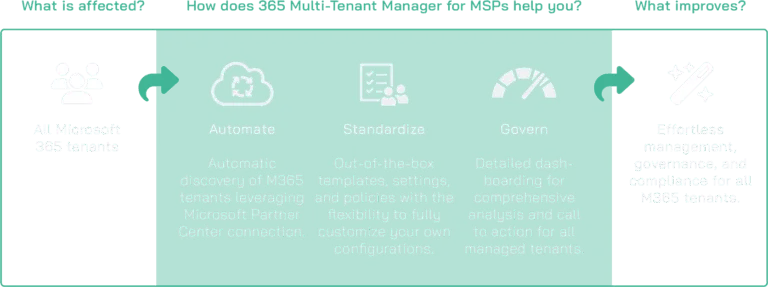
Revamp your onboarding process with Hornetsecurity’s 365 Multi-Tenant Manager for MSPs, delivering a streamlined, effective experience while maintaining uniformity across tenants.

Schedule your demo today and see how a centralized multi-tenant management solution can transform your MSP operations and facilitate onboarding.
Conclusion
Standardization and automation can help MSPs onboard clients more efficiently without adding headcount.
For MSPs, effective onboarding is an integral part of operations that transcends simple checklists. Successful teams adopt a well-defined process for integrating new members. This begins with a straightforward questionnaire, clearly assigns responsibilities at each stage, establishes clear standards, and guarantees a smooth transition.
Such an organized approach not only equips the team for success but also highlights the critical role of efficient MSP onboarding for all parties involved.